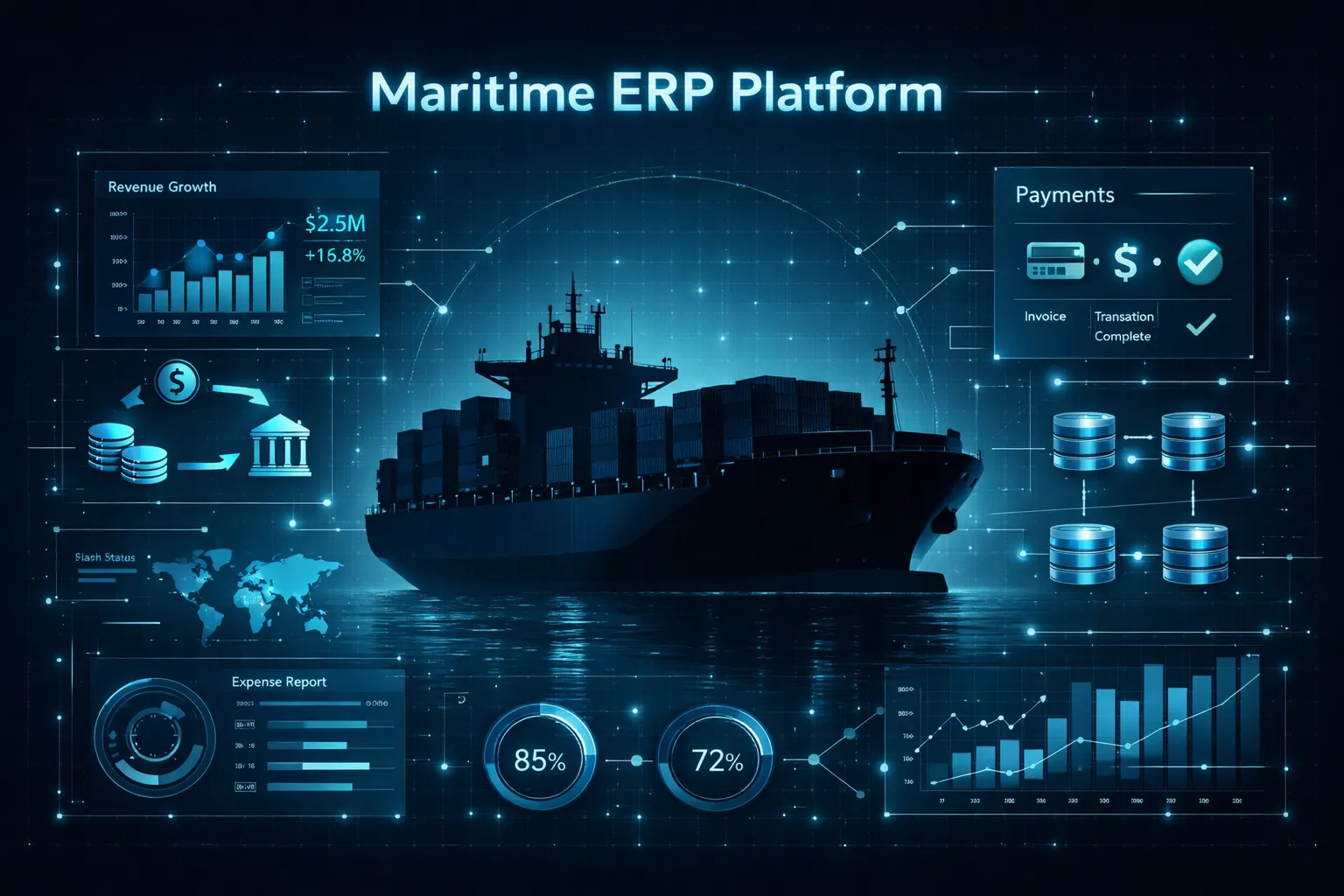
Maritime ERP Platform
ERP system for the shipping domain covering accounting, HR, vessel data, business workflows, and migration from legacy Groovy logic to Spring Boot.
Technologies Used
Key Features
Overview
Developed a full-scale ERP platform for the maritime industry, covering accounting, HR, vessel data management, and complex operational workflows.
The system replaced fragmented legacy tools with a unified, scalable solution, improving maintainability, data consistency, and business process automation across multiple domains.
Technical Challenges
A key challenge was the migration of legacy business logic from Groovy-based implementations into a modern Spring Boot architecture.
This required deep analysis of existing workflows to ensure transactional consistency, correct business rule mapping, and backward compatibility with existing data flows.
The system operates across multiple database engines (PostgreSQL, Oracle, MS SQL Server), requiring adaptable persistence strategies and careful handling of environment-specific behavior.
Handling large Excel-based data inputs introduced additional complexity, requiring robust validation pipelines and efficient data transformation mechanisms.
Key Contributions
Designed and implemented backend modules for payments, invoices, purchase orders, and bank balances, supporting complex business workflows and approval processes.
Engineered multi-step approval flows for financial operations, ensuring data integrity and traceability across transactions.
Led the migration of legacy Groovy-based pages to Spring Boot services, improving system maintainability, testability, and long-term scalability.
Built data processing pipelines for Excel file ingestion, including validation logic and transformation layers, enabling structured data editing directly from the UI.
Contributed to system design through UML activity diagrams and detailed technical documentation, improving team collaboration and onboarding.
Developed advanced Angular Material UI components to support complex user interactions, including:
- Dynamic tables with validation logic
- Nested data structures and grouping
- Virtual scrolling for large datasets
- Reactive forms for enterprise workflows
Architecture Highlights
- Layered Spring Boot architecture with clear separation of concerns
- Transaction management for financial workflows
- Multi-database compatibility strategy
- Modular design supporting system scalability and future extensions
Outcome
Delivered a production-ready ERP system that unified multiple business domains into a cohesive platform, improving operational efficiency, reducing manual processes, and providing a scalable foundation for future system evolution.