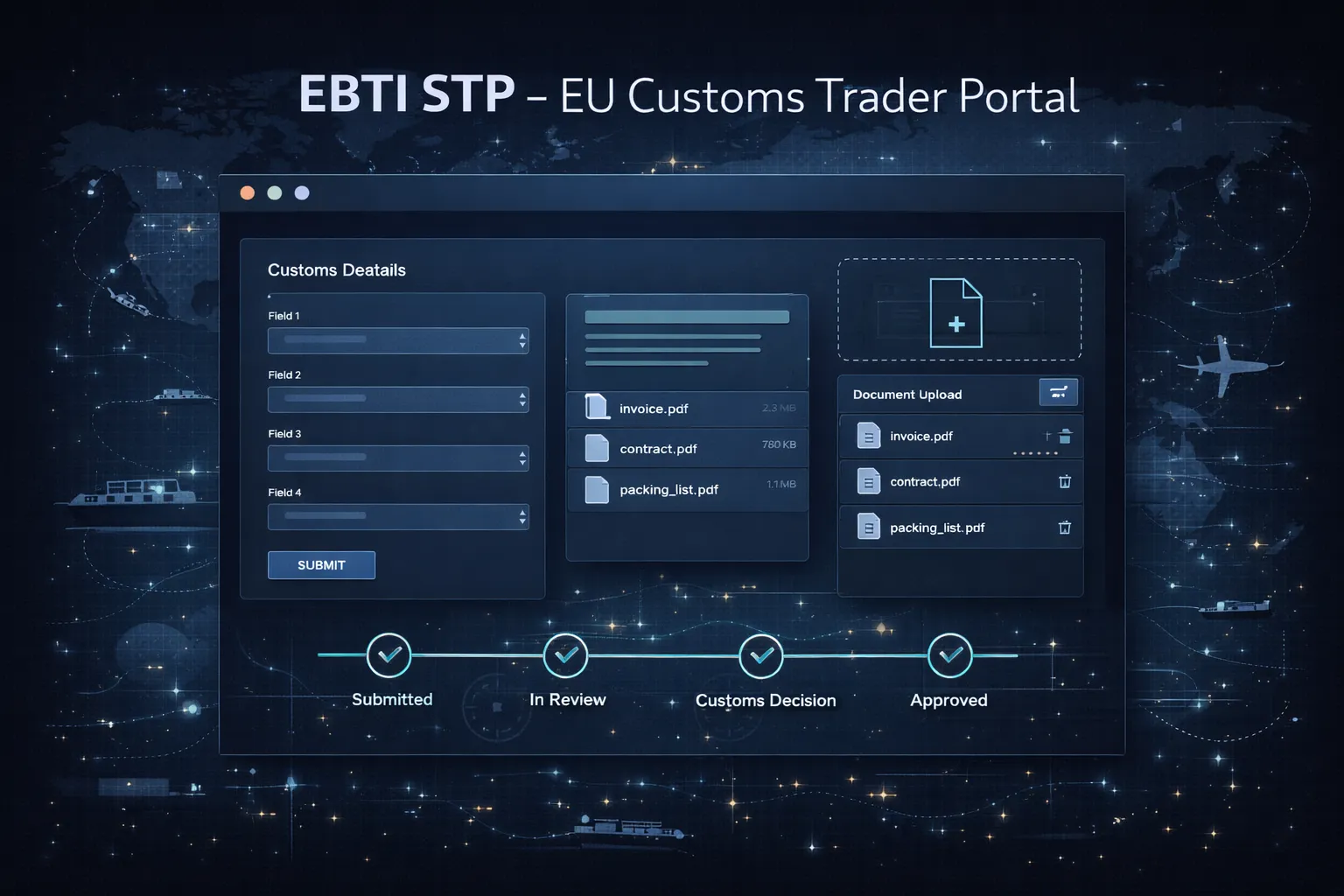
EBTI STP — EU Customs Trader Portal
Trader-facing portal of the European Binding Tariff Information system, enabling economic operators to submit and manage BTI applications through the EU Customs Trader Portal.
Technologies Used
Key Features
Overview
EBTI STP (Single Trader Portal) is the trader-facing side of the European Binding Tariff Information system. It is part of the EU Customs Trader Portal, the single access point through which economic operators (importers and exporters) submit BTI applications, track their status, and manage tariff classification decisions.
A Binding Tariff Information (BTI) decision is an official customs decision that confirms the tariff classification of goods, giving traders legal certainty when moving goods across EU borders. EBTI STP enables traders to interact with this process digitally, while the back-office processing is handled by the companion system, EBTI CS.
The flow follows: Trader Portal (STP) → National Customs Authority → Central EBTI System (CS).
What I Worked On
- Contributed to Java EE backend services handling BTI application submissions, status tracking, and workflow management for traders interacting with the customs system.
- Worked with SOAP-based web services for communication between the trader portal and the central EBTI system, following EU integration patterns.
- Managed complex relational data models in Oracle SQL, supporting application records, status tracking, and referential integrity required for regulatory compliance.
- Delivered Angular frontend features for traders to submit applications, upload documentation, track decision status, and manage their BTI interactions.
- Implemented automated testing with JUnit and Selenium, and worked within a Jenkins CI/CD pipeline for controlled, repeatable releases.
EU Context and Impact
The EBTI system is one of several large-scale IT systems operated within the EU customs domain. It integrates with the broader EU customs infrastructure, supporting cross-border trade by providing legally binding tariff decisions that are recognized across all EU member states.
By digitizing the BTI application process through STP, the system reduces manual paperwork, accelerates decision timelines, and provides traders with a standardized interface for customs interactions across the EU.
Outcome
Working on EBTI STP gave me hands-on experience with large-scale EU system development, Java EE backend services, SOAP integration patterns, Oracle SQL data management, and the strict testing and release processes required in regulated institutional environments.